One of my secrets for getting lots of fresh vegetables in my diet is to eat a salad every day for lunch. I make the salad and dressing myself – prepping and packing it to go when necessary.
Salads are a very healthy choice, but salad dressings are usually full of calories, sodium, added sugars, and saturated fat. In fact, ordering a salad at a restaurant is usually not going to be the healthiest option on the menu, despite what you would assume.
So, I’ve been creating my own salad dressings to avoid unhealthy store-bought varieties. For a time, I would premix a vinaigrette of sorts, but I got lazy and wanted something I didn’t actually have to make ahead. Now, I create my salad dressing right in the bowl with the following ingredients:
Extra virgin olive oil
Italian dressing seasoning mix (homemade according to this recipe by The Midnight Baker)
Lemon juice (freshly squeezed, when possible)
You could use the Italian dressing mix to – duh – make Italian dressing, but this stuff is DELICIOUS as just a plain seasoning. I originally found the recipe in order to marinate some chicken. The chicken turned out delicious and the dressing really tasted like Italian; however, I wanted to just mix my dressing in my bowl with a few ingredients I always have on hand.
I essentially make the dressing, but in my bowl – and I use lemon juice instead of vinegar because it’s a more natural option and adds a more summery, citrus flavor. I just cut a lemon in half and squeeze a little juice right into the bowl.
This salad dressing tastes like summer. I’m not kidding.
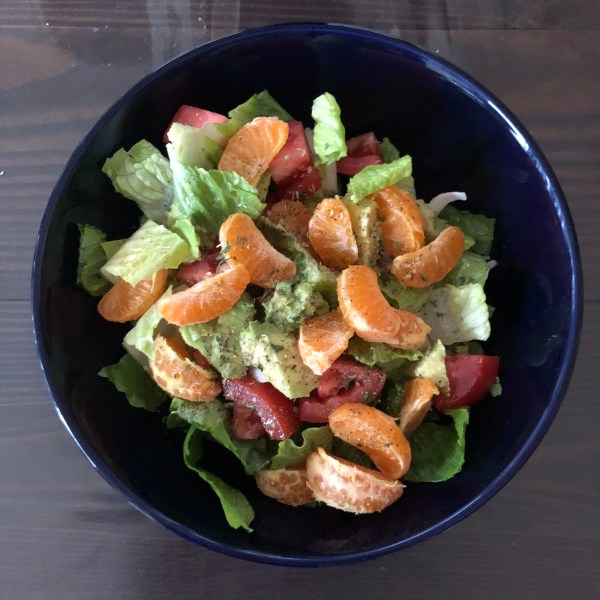
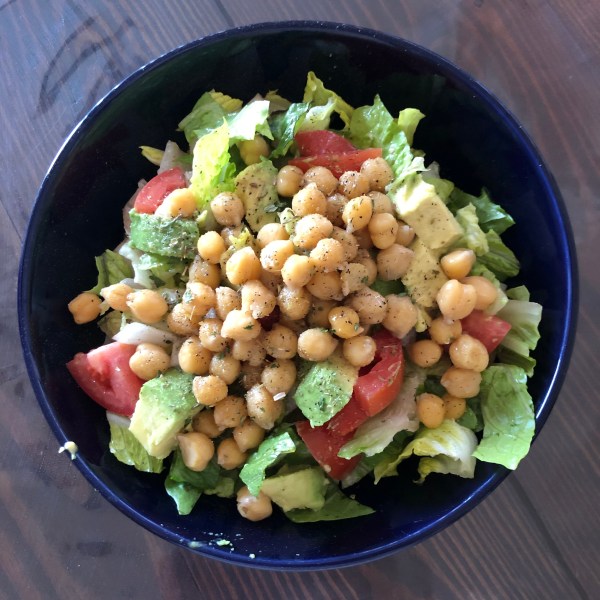
Then I get creative with my toppings.
Other toppings I frequently add: almonds, capers, olives, peppers, cucumbers, etc
Don’t let your salad get boring!
And don’t let your salad dressing derail your healthy eating habits!
Since I first moved out on my own, I have been trying to figure out this whole grocery shopping thing – how to eat well without overspending money or time.
I have tried everything – from couponing to rebate apps to stockpiling boxes of granola bars[not healthy, by the way]. I shopped exclusively at Aldi for a time. I followed popular shopping bloggers and ran to the store every time they said there was a good deal.
None of these things worked for me. They were all time-consuming and exhausting and didn’t actually seem to save me much money and on top of all that, we weren’t eating healthy foods.
So I’ve been trying to figure out how to spend less on groceries without sacrificing quality or healthfulness.
After ten years, I have FINALLY reached a place where grocery shopping is no longer expensive, time-consuming, or unhealthy. I spend less time meal planning, less time at the grocery store, and less time stressing over the grocery budget than I ever have.
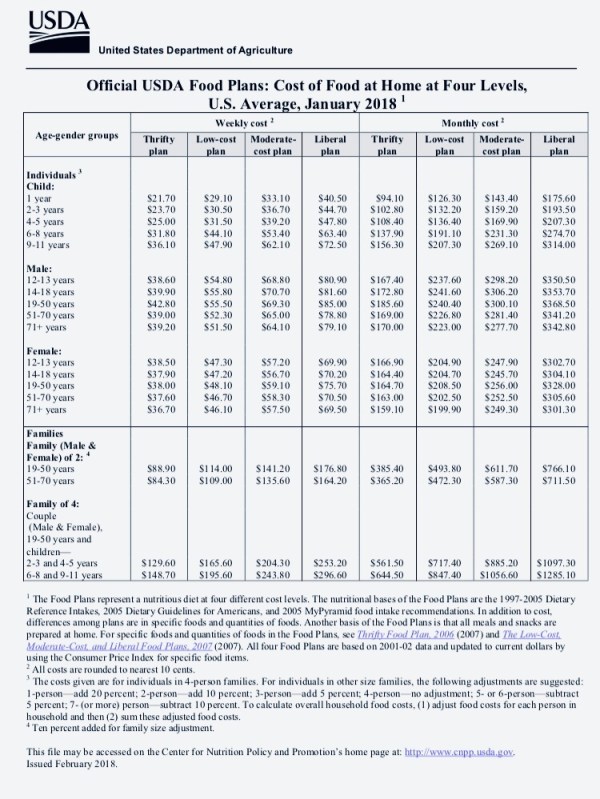
To give you an idea of how much you can save, here are USDA’s recommended grocery budgets.
They vary based on the number and ages of you family members and based on whether you are living lean [“Thrifty plan”] or high on the hog [“Liberal plan”].
So according to this chart, for my family of five, a thrifty plan would be $561.50 per month, if I don’t count my youngest who is only 18 months old, or $655.60 if I do count her.
Doesn’t really matter because our budget is $400/month. This doesn’t include our eating out budget which is $60/month and allows us to eat out about twice per month. Also, every other month we cut our budget in half [a lengthy explanation of which I may write and post someday]. So, technically, we feed our family for $300/month, if we average it out.
That may sound like a lot or a little to you depending on your situation, but for us, it is less than half of what Brett and I were spending back when it was just the two of us – and we weren’t eating nearly as healthy as we do now.
[I’m harping on the healthy thing because anyone can eat ramen noodles every day and save tons of money, but I have found that I can eat super healthy – I’m talking fresh produce and high quality foods – and still save money. So if you are one of the many people today who believe that eating healthy is more expensive, please read on.]
So how do we feed our family healthy foods with so little money? Well, for starters we buy very few processed foods [for our health] and we do our best to avoid packaged foods [for the health of our planet]. Those two things contribute a little bit to our savings – but I know that they are not the reality for the average American [though I wish they were].
The bulk of the money and time is saved by following these five simple rules:
1. Buy what is on sale.
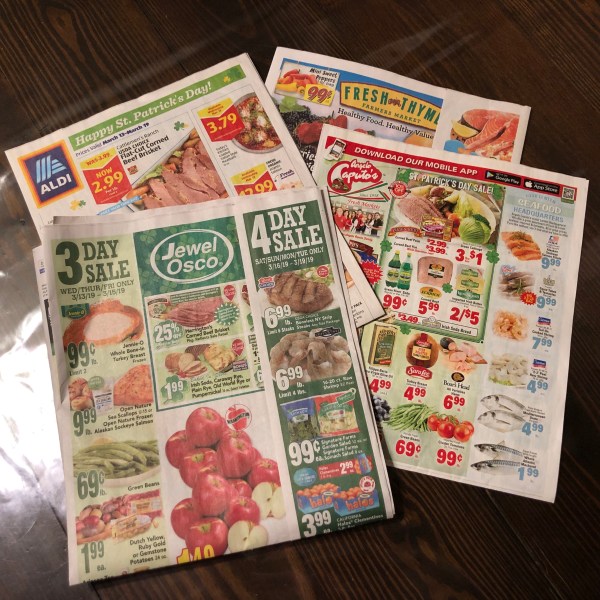
Rather than creating a meal plan and then buying the ingredients regardless of the price, I let the weekly ads determine what we eat each week. In my area, each Wednesday, grocery stores roll out new ads with new deals. I compare the ads from four different local grocers and then choose the one [or maybe two] with the best sales and that’s where I’ll be shopping that week.
Besides simplifying meal planning, another benefit of this rule is that it saves a lot of time at the grocery store. I know exactly what I’m going in to get. I don’t need to price compare a bunch of different options, or stroll down aisles looking at different food choices, or fall prey to the clever marketing tricks like flashy signs and end-caps. I go in, get what’s on sale, get out.
Bottom line, if it’s not on sale, I don’t buy it.
[As with all rules, there are exceptions. In the case of rule #1, I don’t buy my bulk dry goods on sale because most stores don’t offer regular sales on bulk goods. In this case, I am prioritizing my obligation to the health of the planet over money – ALWAYS a good choice, by the way. But I still save plenty of money.]
2. Set price limits.
Over the past two years I’ve learned what a good sale price is for most items and I have set rules for how cheap they need to be. Simply being “on sale” is not necessarily good enough. Not all sale prices are created equal. For example, it is extremely rare that I will buy produce at Aldi because their sale prices are never as good as my other local grocers. If you [as most people do] assume that Aldi is cheaper for everything simply because it’s Aldi, then you are overpaying.
This week, 1lb of strawberries is $1.69 at Aldi and $.88 at Fresh Thyme. In fact, everything on this Aldi ad can be found cheaper elsewhere.
In order to figure out what a good sale price is, you have to pay attention to sales in your area over a period of months. My price limits are still changing as time goes on. For example, I used to only buy boneless chicken if it was under $2/lb, but after a while I learned that I could find it at least once a month for $1.49/lb. So that became my new price limit.
Here are some examples of my price limits [understand that prices will vary greatly depending on your location]:
I won’t buy produce for more than $1/lb. Sometimes I do buy blackberries at $.88/6oz package and I will buy avocados if they are $.79/each or less, but I don’t make a habit of buying these items because they are so expensive compared to normal produce.
I won’t buy cheese for more than $1.50/8oz package. If cheese is not on sale for this price or less, we just do without cheese. It’s not even really a hardship. In fact, I think it has improved my children’s appreciation for the taste of real foods not covered in cheese.
I won’t buy eggs for more than $1/dozen. Though, I admit, I am going to buy eggs from our farm CSA this summer at $5/carton, but in this case, I am prioritizing supporting local agriculture and health over saving money. I will also be limiting our eggs to one carton per week.
Your rules will depend on what eat, but everything should have a price limit required for purchase. There will always be off cases when you simply must have something – like butter to make buttercream for your son’s birthday cake – and it’s not on sale. Okay. Sometimes we have to bend the rules.
3. Eat less meat…and live longer and healthier lives.
I’m a fitness professional, not a registered dietician or nutritionist, so you don’t have to agree with me on the healthful side of this rule. Eat meat if you want, but know this, meat is WAY MORE expensive than plant-based foods. We used to make two or three chicken breasts for our family of five for dinner. Now, we all share one chicken breast [oftentimes less] and fill the majority of our plates with vegetables, fruits, grains and legumes.
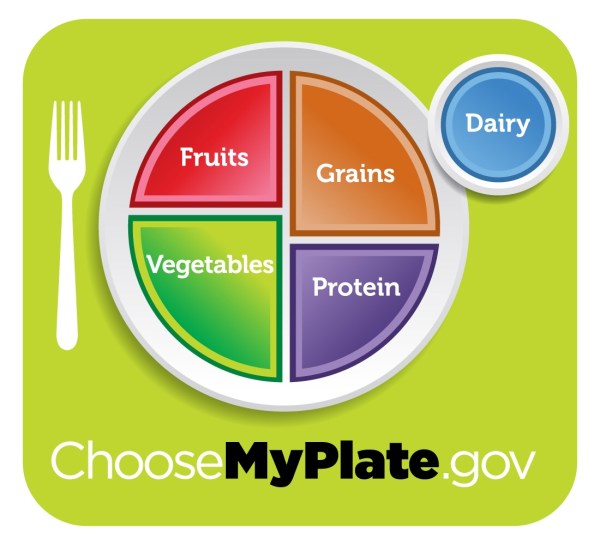
This is the USDA’s newest recommendation for healthy eating which has replaced the typical food pyramid we all learned in grade school.
Notice that three quarters of the plate are filled with plant-based foods. Now think about how your dinner plate typically looks. Most Americans eat a meat heavy diet, with the protein being the main course and the vegetables and fruits being “sides.”
If you need further evidence, watch the documentary, In Defense of Food, or read the book with the same title by Michael Pollan.
Time to rethink the way we eat…and hopefully soon because the health epidemic in our country is quite literally frightening. But the good news is, eating more plant-based foods is CHEAPER!
Also, according to the chart below by health.gov, over 85% of the population is not eating the recommended amount of vegetables…
C’mon, people. Let’s eat some more veggies!
[Someday I’ll go into greater detail about how to eat healthy on a budget. It is not hard, folks. I promise you!]
4. Buy less food.
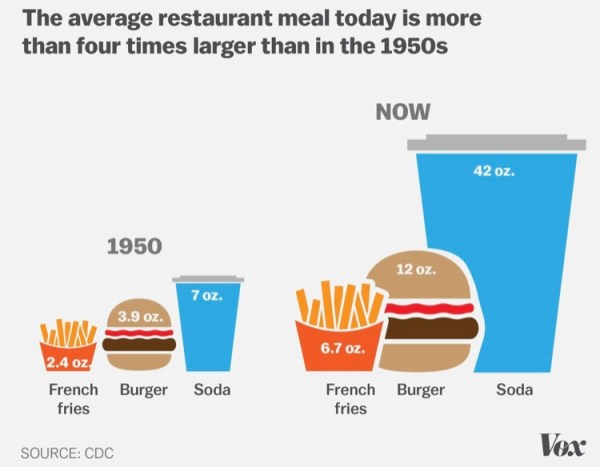
This might sound obvious, but apparently it needs to be stated anyway because we have a bit of an overeating problem in America.
According to the CDC, 39.8% of adults in the US are obese [read about it here.] And, shockingly, according to this article by NPR, 75% of Americans believe themselves to be eating healthy…so why are obesity rates so high?
There are lots of factors that contribute to the obesity issue, but no matter where you look, portion size and overeating are partially to blame.
Nutrition scholarMarion Nestleat New York University says portion size — just eating too much — is an issue. “I’d vote for that as a major cause of obesity,” Nestle told us by email.
“Some of the problem is that individuals pay more attention to getting good things in their diet than they do to limiting overall intake,” addsDavid Just, a behavioral economist who studies food psychology at Cornell University.– npr.org
The accessibility of food in our society has made overeating too easy. Yes, restaurants serve us too much food, but we also serve ourselves too much food at home. We also stock too much food in our kitchen, making it too easy to eat whatever we want whenever we feel like it.
Let’s all do ourselves a favor and buy less food. There is no reason to stockpile canned goods as if we are fearing an imminent apocalypse…unless you are fearing an imminent apocalypse…in which case, there is no need to save your money because it will be useless when the zombies take over.
Some basic ways to buy less food is:
Go grocery shopping once a week and only buy what you need for that week.
Buy fresh produce so you CAN’T stockpile it. Fresh food is healthier, more likely to be local, and tastes WAY BETTER!
Don’t buy [or buy very little] unhealthy snacks and treats. Don’t spend your hard-earned money on food that is going to make you sick and unhappy in the long run.
Avoid processed and packaged foods – for the sake of your wallet, your health, and the planet.
5. Eat all the food you buy.
Again, this seems obvious…but apparently it’s not because 40% of food in America is thrown away.
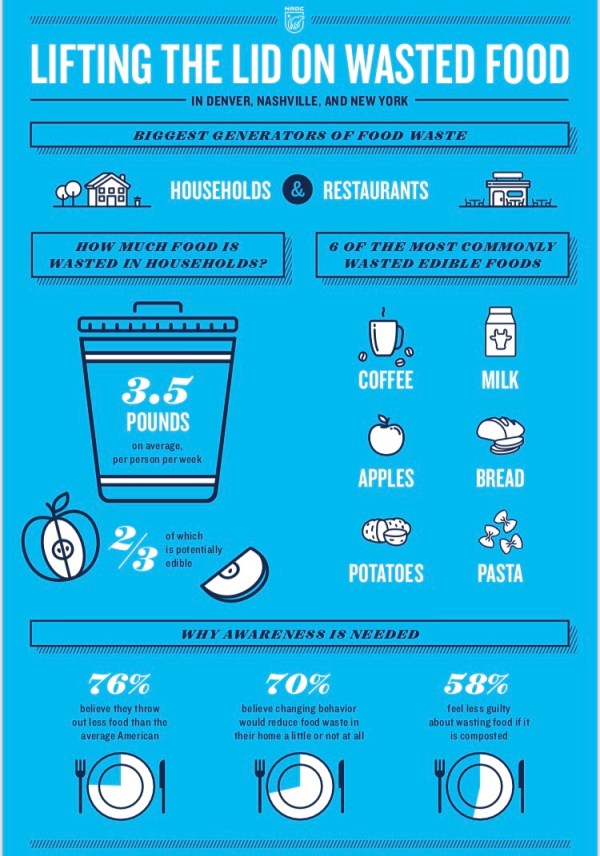
In 2012, NRDC published a groundbreaking report that revealed that up to 40 percent of food in the United States goes uneaten. That is on average 400 pounds of food per person every year. Not only is that irresponsible—it’s expensive [emphasis mine]. Growing, processing, transporting, and disposing that uneaten food has an annual estimated cost of $218 billion, costing a household of four an average of $1,800 annually. – NRDC report by Dana Gunders, source
And before you go blaming it all on grocery stores, this infographic created by the NRDC says that households and restaurants are the biggest generators of food waste [at least in Denver, Nashville and New York].
Of course, on the other hand, we have lots of families in our country who struggle to put food on the table.
So besides the cost of wasted food, I feel just plain terrible knowing that I am throwing food awaywhen some people are not eating today. And I feel like a terrible hypocrite if I talk about our grocery budget being “tight” while I’m throwing food in the trash – or even in the compost bin.
In my home, we do everything we possibly can to avoid wasting food. Some of the ways to reduce our food waste are:
Eat all the leftovers. I set designated days at least once but often twice per week to eat whatever we have that is close to expiring.
Only buy what you need for a week. You may not know what you need for a week, but if you find yourself throwing food out, then you know for next time that you need less. Obviously some things with longer shelf lives, like dairy products and dry goods, don’t need to be purchased weekly. That leads me to the next tip:
Don’t buy more if you still have food to eat. I don’t know why we do this but it seems that it’s totally normal to go buy a full cart of groceries when we still have enough food in our home to feed our family for the next six months. I’m not joking. When we got ready to sell our last home, I started using up all the food that we had in our cabinets and pantry and – oh my gosh – our second freezer. Lo and behold, we had enough food to feed us for months. I decided then and there that stocking so much food in our house was wasteful and expensive and I stopped doing it.
A word on frozen and non-perishable foods: Some people prefer to buy non-perishables because they feel like they throw out more food when they buy fresh – which they really might. The problem is not the fresh food – it’s that there is a disparity between the amount they are buying and the amount they are eating. As I said previously, fresh food is healthier, more likely to be local, and tastes WAY BETTER! Buy fresh food – just not so much – and then EAT IT!
So, this has been a book. If you’ve stuck with me, I hope you’ve found some useful information and, hopefully, some motivation to improve your spending and eating habits.
These are all things I wish someone had told me a lot earlier, but everything I found about saving money on groceries revolved around making a list, not shopping hungry, and clipping coupons. I wanted something that saved me time AND money AND made me a healthier consumer.
For me, this is it.
If you’ve found a method that works for you, share it in the comments! We all have room for improvement!
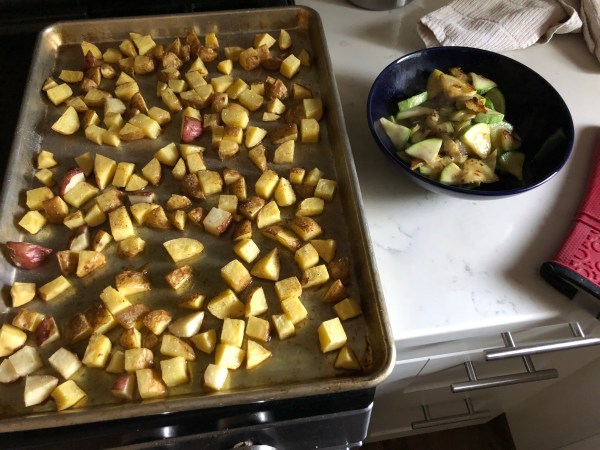
I was considering preparing eggplant as well, but I realized that the potatoes and squash provided plenty of food [there was even enough for leftovers].
I read an autobiography earlier this year called Kisses from Katie by a young woman who left her privileged American life to live in Uganda and love on the people in her village. One story she tells is how she was preparing beans for dinner for her family and she didn’t realize how long it takes to cook dried beans – but the story was a lesson for me that we are far too opinionated around here about what constitutes a meal.
They were eating beans for dinner. That’s it. Just beans. And here I am feeling like my meals have to contain at least five different food groups AND be beautifully presented.
Dinner doesn’t have to have courses, or side dishes, or any specific food group. It doesn’t have to be colorful, or appealing to look at, or come from a recipe. Dinner could just be food – preferable real, healthy food. And in our house tonight, dinner was just two vegetables that I cooked and we all ate until we were satisfied.
[The kids asked for seconds.]
What I love most about our new simple lifestyle is that our food is simple. The meals are simple. The preparation is simple. The ingredients are simple. And they are healthy.
There are many homes in America where a box of mac and cheese is a standard meal for the kids [and I’m not judging because I’ve definitely been there and done that]. But I almost felt guilty about what I fed my kids tonight, and it was literally just vegetables. It may not have been colorful or fancy or a lot of variety, but it was healthy and it was filling and it was tasty.
And it was from our CSA, which I love more and more.
Don’t get me wrong – there are nights when we have company and I pretend that I love to cook and prepare three-course meals and a home baked dessert. But most nights are simple.
Maybe not usually quite this simple…but pretty simple.
Yesterday was CSA pickup day at Rustic Road Farm, so our fridge is now stocked once again with farm fresh veggies!
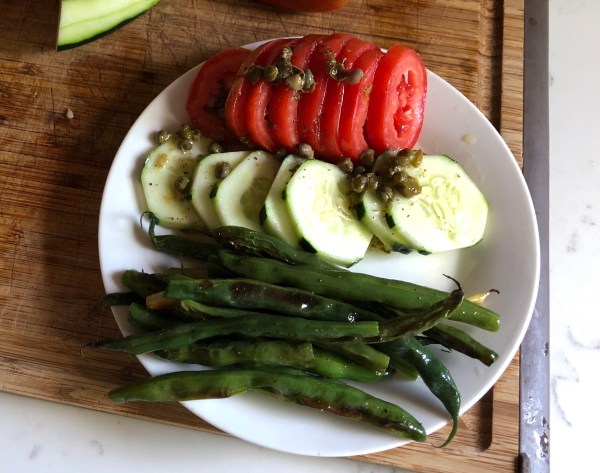
I pulled tomatoes, cucumber, and green beans for lunch today.
[Side note: I have developed a deep and passionate love for fresh green beans now that I have stopped buying them canned or frozen. Even if the waste wasn’t an issue, I don’t think I would ever go back to packaged green beans.]
I steamed then sautéed the green beans [total of seven minutes] and drizzled the fresh cucumber and tomato slices with my homemade caper vinaigrette and VOILA!
Farm fresh lunch!
[Side note: there is no rule that says “salad” has to contain leafy greens or be in a bowl. I like to deconstruct my salads and basically use any veggies I have with a little oil and vinegar.]
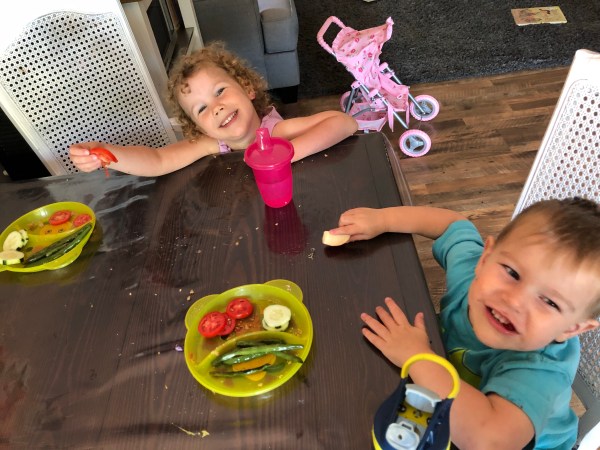
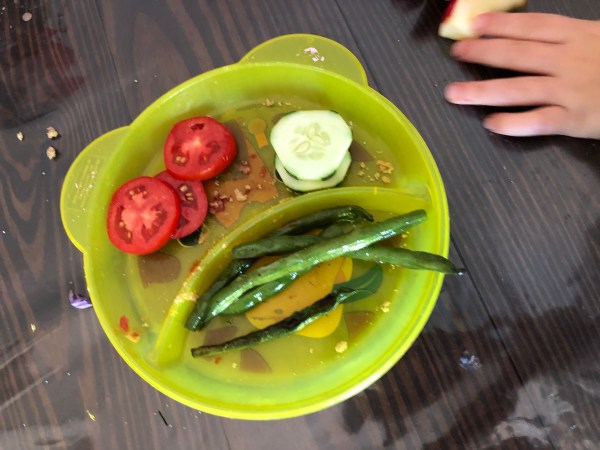
My kids ate the same thing.
[They also ate peanut butter and jelly sandwiches, because 1) we are creatures of habit, and 2) I make the peanut butter, jam, and whole wheat bread from scratch, so it is a pretty healthy meal containing whole grains, fruit, and nuts – then with the addition of the vegetables, it is a well-balanced meal.]
Even my baby girl ate the veggies after her PBJ.
I’m very lucky that my kids love vegetables – but I don’t think it’s ALL luck. Here are some of the things I do to help my kids love vegetables:
1. I assume that they will like vegetables. I think we sometimes condition our kids to dislike vegetables by speaking of them negatively or not even offering them because we assume they won’t like them or forcing them to eat their vegetables in order to get a treat. I purposefully assume that they will like the vegetables. That is partly because I love vegetables. I think that vegetables are AWESOME, so why wouldn’t my kids like them??? Which brings us to number two:
2. I eat a lot of vegetables. I can’t expect my kids to want to eat them if I don’t. I even eat vegetables that I don’t like. I’m not a big fan of cucumbers, but turns out my daughter Evangeline loves them. Brett hates tomatoes, but all three of our kids LOVE them. I eat vegetables every day for lunch which has made my kids view salads as a totally normal meal. I frequently serve them a salad alongside their PBJ – and they always eat THE WHOLE THING. In fact, I started because they used to ask me for bites of my salad so much that there would barely be any left for me to eat so I started just making them their own. I don’t even give them ranch dressing [which, as we all know, is the child-approved way to eat salad]. I make theirs just like mine – with oil and vinegar.
3. I serve a wide variety and large quantity of vegetables. My kids typically eat mostly vegetables at mealtime. They eat a lot of different kinds. Each one of my kids has their own favorites, but they always eat a variety. I always offer at least two different vegetables – but usually more. This way, the meat [if I’m serving any] and starch become the side dishes and the vegetables become the star of the meal [which is the key to healthy eating, by the way].
4. I start them young and don’t stop. I think most people start their babies with vegetables, but eventually start mixing the vegetables with fruit and then slowly over time the vegetables become a smaller part of a kids diet, overtaken by cereal and yogurt and bread and meat and cheese and French fries…things that we typically eat more of as adults. It must be because I eat so many vegetables that I naturally just keep feeding my kids the same stuff I eat.
I can’t say for sure that these things are the only factors, but my kids will typically eat all the vegetables off their plates first and then have to be told to eat their meat.
Don’t get me wrong, they really like mac and cheese too. And tonight we are going to a ball game and they are going to be super excited to eat hotdogs. But, hopefully, overall, they are going to keeping loving their vegetables and being healthy eaters for the rest of their lives.
🤞🏻
That’s every mom’s dream for their kids – that they be healthy – right?
As promised, I’ve been tracking my food. Honestly, it hasn’t gone as well as I had hoped. On Saturday I fell off the healthy eating bandwagon and I haven’t gotten quite back on yet. But that is real life. It has been an education for myself about my eating habits and I’ve learned a few interesting things about myself in the process:
1. Brett and I have gotten into a bad habit of having pizza delivered when we are hanging out late at night. This is both terrible for my health and our budget. I don’t even know why I get such pizza cravings when I KNOW it will literally make me sick for at least the whole next day and usually several days – not to mention it does not make baby JoElle feel well either.
2. I am an emotional eater. I can’t believe this is a revelation to me, but I was always under the impression that I’m not very emotional at all. For the last seven years, I have been channeling my emotions into physical activity [which is largely what has allowed me to become a long distance runner]. But, since having my third baby, I am not always able to dedicate two hours each morning to exercise – which really messes with my emotional balance – and results in late night snacking on things I wouldn’t ordinarily eat.
I’m making it sound worse than it is – but I am about to be totally honest about the things I consumed over the last few days.
First of all, I ate the same breakfast – [oatmeal with maple syrup and raisins] and the same lunch [cabbage and kale salad with oil and vinegar] each day, so I’m really only going to share what I had for dinner, unless it differed from above.
Wednesday, July 18th:
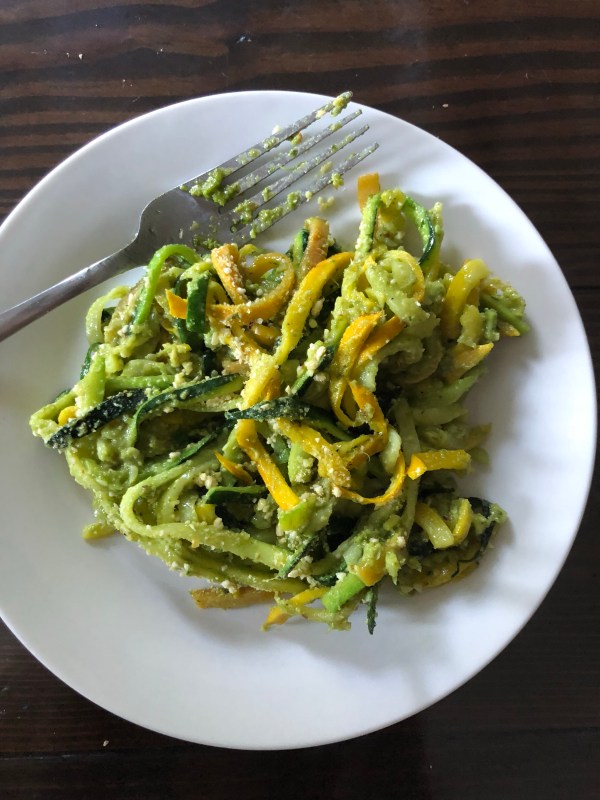
Zoodles [and Squoodles?] with Pesto
Spiralized zucchini and summer squash with homemade vegan pesto [kohlrabi leaves, garlic scapes, almonds, olive oil, and homemade vegan parmesan]
Thursday, July 19th:
Sautéed summer squash, cabbage, garlic scapes and onion, roasted cauliflower
For a snack I ate homemade cantaloupe bread.
[As someone who doesn’t love cantaloupe – the bread was AMAZING! Made just like banana bread, but with cantaloupe instead of bananas which made for a perfectly sweet and delicious quick bread that the whole family loved.]
Friday, July 20th:
Leftover sautéed cabbage and steamed broccoli
For a snack later that evening I ate roasted cauliflower and eggplant chips.
Saturday, July 21st:
So this is where the healthy eating derailed…
Brett and I were up at 5:15am to get our kids packed up and dropped off before running a half marathon.
My pre-race breakfast is always toast [in this case, homemade whole wheat bread] with [homemade] peanut butter, maple syrup and a banana.
After the run, I ate an apple and grapes and was still starving so we ordered bacon, egg, and cheese croissants at Dunkin’ Donuts and split a donut.
For dinner we had roasted sweet potatoes, black beans, and grilled corn in a sort of burrito bowl. I topped mine with onions, tomatoes, lettuce and hot sauce.
Which was great, BUT…
…then, we ordered pizza and cheese bread while we tiled the bathtub surround until 2:30am.
Sunday, July 22nd:
My kids we’re up at a shocking 5:30am and I had to take them all to work with me that morning so I ended up eating no breakfast and leftover pizza for lunch. For dinner Brett picked up sushi for me and a rotisserie chicken for the kids.
Monday, July 23rd:
Despite a good workout in the morning, I just couldn’t get back on the healthy bandwagon today. I had my usual oatmeal for breakfast, pretty much no lunch and Brett picked up wok n fire sushi rolls for dinner.
So, this week was supposed to be an “on” week for the veggie diet, but it didn’t really happen. I ate meat and seafood, cheese and breads, chocolate and [gasp] donuts. I don’t even like donuts!
Well, I guess this is healthy eating in real life!
***Read about my 2019 [Nearly] Vegetable-Only Diet HERE***
*I could have entitled this post “How I lost 20 pounds in 3 weeks,” but that sounds like I’m trying to reel you in to sell you a self-published cookbook or something, so instead I gave you the honest point of the post upfront. Because that’s what people who write on the internet should do. That way, if you are interested, you can read it, and if not, you don’t need to waste your time.*
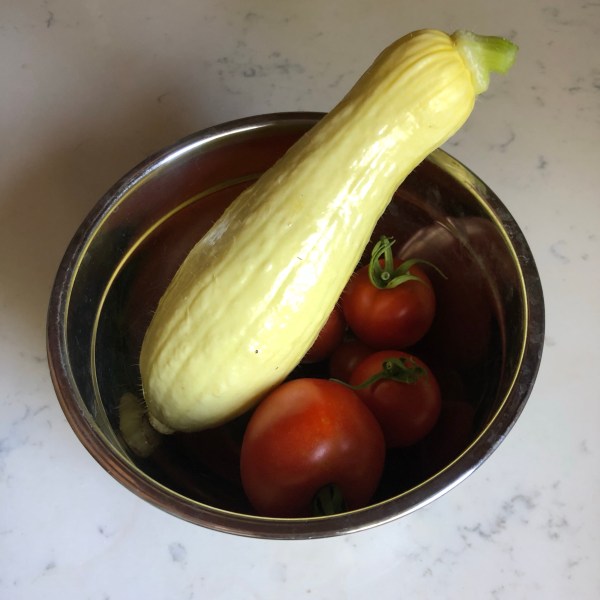
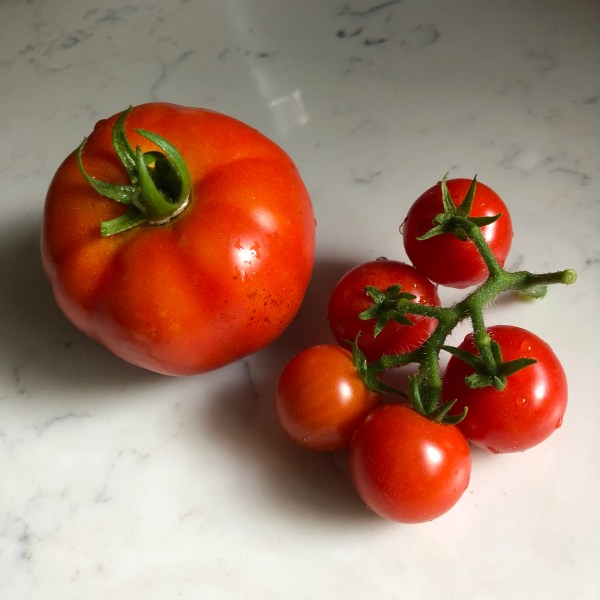
But first, our garden is producing vegetables!!!! FINALLY!
Aren’t they beautiful?
[I’ve already picked many more tomatoes but I always eat them immediately.]
Here they are on the cabbage and kale salad that I ate for lunch today:
This is just a small sign of the wonderful things to come in the next few weeks. We also have cucumbers, zucchini, summer squash, bell peppers, kale, green beans, broccoli and [crossing my fingers] carrots nearly ready to be harvested!
Unfortunately, the snap peas and spinach are not going to make it this year and I have no idea what’s happening with the onions [them being underground and all]…but that’s why we got the CSA.
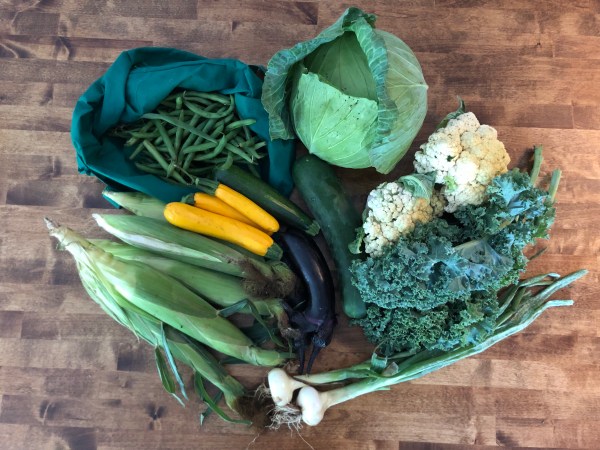
Secondly, our CSA this week has provided some of my favorite vegetables!
Corn, zucchini, summer squash, cauliflower, green beans, cucumber, eggplant, kale, MORE green onions [I am so overrun with green onions!] and, of course, more cabbage.
So, anyway, we’ve got to get busy on the vegetable front – which brings me to the point of all this…
Third and finally, I have been experimenting with a plant-based, MOSTLY vegetable diet off and on since February. This isn’t an official diet with a name or a book – I completely made it up and created my own rules based on my [slightly educated] understanding of healthy eating [and a fair share of Netflix food documentaries – cuz I’m obviously a sucker for those].
The “diet” [a word a hate using because of its negative connotation, but that I am using here to mean “the foods that I consume”] has sparked many conversations with coworkers and friends and my personal training clients because I lost a relatively significant amount of weight in a relatively short amount of time.
[As a personal trainer, I have to mention that this was baby weight – though some of it had been hanging around since Evangeline was born – and typically it is not healthy to lose more than 1 or 2 pounds per week.]
Everyone wants to know what I’ve been doing to lose weight. The answer is simple. I’ve been eating vegetables – pretty much ONLY vegetables. The other things I eat are fruit and legumes and nuts. The only grain I eat is rolled oats for breakfast each morning, sweetened with pure maple syrup. I use extra virgin olive oil for cooking and I make my own oil and vinegar dressing for my salads.
Oh, and herbs and seasonings – but those are vegetables too…right? Except maybe salt? Anyway…
And sometimes hot sauce.
I eat all of the legumes, nuts, fruit and vegetables in their most natural form – not canned, not chopped, not cooked, not prepped in anyway. I do all that myself.
I drink coffee in the morning and water the rest of the day.
That’s it.
The next question that ALWAYS follows is, “But what do you eat for meals?” because in American culture, meals are built around meat or bread or rice, so the thought of eating a meal without any of those is perplexing.
I was there too – on day one of this thing, staring at my plate of steamed broccoli for dinner. But I’ve gotten much better at it since then.
So, to help people see what I actually eat, I’m going to log my food [not track my calories, btw, because that is unnecessary when eating this way] and show everyone what a [nearly] vegetable-only diet looks like.
[I don’t eat this way all the time, either. I rotate between this and a less strict diet that includes some meat, but I am off the dairy bandwagon forever I think – especially after making my own vegan Parmesan and discovering Haagen Das’ non-dairy ice cream! Who needs dairy when the alternatives are BETTER????]
Anyway, vegetables are actually quite delicious and I feel really good when I am eating this way.
















 No Makeup Mama